Apartment·Privater Gastgeber
Historic Beautifully Preserved 1800’s Retreat - Large 1bd Apt in PJ Village
Fotogalerie von Historic Beautifully Preserved 1800’s Retreat - Large 1bd Apt in PJ Village


Bewertungen
10 von 10.
Außergewöhnlich
1 Schlafzimmer1 BadezimmerPlatz für 4 Gäste65.0 m²
Beliebte Annehmlichkeiten
Lerne die Gegend kennen
Port Jefferson, NY
- Place, St. Charles Hospital5 Gehminuten
- Place, Harborfront Park6 Gehminuten
- Place, Port Jefferson8 Gehminuten
- Airport, Islip, New York (ISP-MacArthur)30 Autominuten
Zimmer und Betten
1 Schlafzimmer (Platz für 4 Personen)
Schlafzimmer 1
1 Queen-Bett
Wohnzimmer 1
1 Queen-Bett
1 Badezimmer
Badezimmer 1
Seife · Handtücher werden bereitgestellt · Toilette · Nur Dusche · Shampoo · Haartrockner
Weitere Räumlichkeiten
Terrasse oder Patio
Veranda oder Lanai
Separater Essbereich
Garten
Essbereich
Mehr zu dieser Unterkunft
Historic Beautifully Preserved 1800’s Retreat - Large 1bd Apt in PJ Village
Timeless Fusion Retreat: A 1846 Historic Haven in Port Jefferson Village
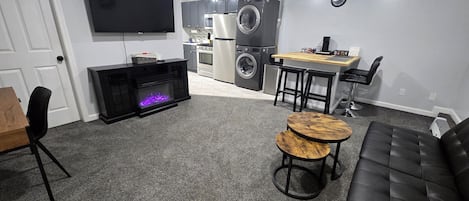
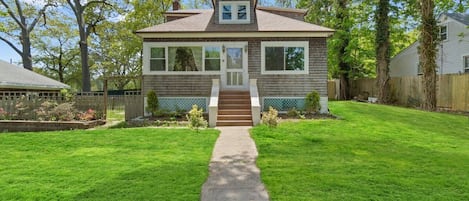
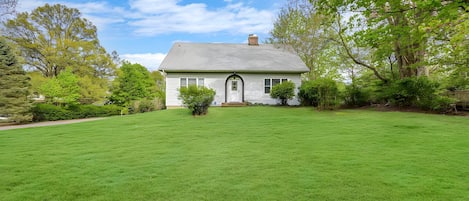
Step back 180+ years in time to this charming large 1-bedroom apartment in a beautifully preserved early 1800’s historic—NYS Registered—home built by a 19th century ship wright, builder and sea captain (with a colorful past) in the heart of Port Jefferson Village. Perfect for couples or small families seeking a serene and cozy getaway, this spacious retreat blends vintage elegance reflecting the 1846 historic charm, 1920s Art Deco, 1950s mid-century, and 2025 modern elements, with modern comforts—think commercial gas stove and oven, dark wood floors, high ceilings, and large windows flooding the space with natural light all day long. Private and secluded right in the middle of the village. Don’t feel like cooking? You’re two minutes from 20+ restaurants. Free parking, Wi-Fi, and laundry included. Book now for your escape! Old homes aren’t for everyone, they say sometimes the home picks you—we were fortunate to have had this home pick us!
To truly appreciate the Timeless Fusion Retreat at 118 South Street, one must delve into the rich tapestry of its history, a story woven from the salt-sprayed sails of Long Island’s maritime golden age and the enduring spirit of American ingenuity. Constructed circa 1846 by Edward Hawkins, a master shipbuilder whose life embodied the rugged determination of 19th-century American enterprise, this Greek Revival gem stands as a living monument to Port Jefferson’s pivotal role in the nation’s seafaring legacy. Born on July 14, 1819, in the quiet hamlet of Bayport, Long Island, Edward learned the craft of shipbuilding in Derby, Connecticut, honing his skills amid the clatter of hammers and the scent of fresh-hewn oak. By the early 1840s, he had returned to his native Suffolk County, establishing himself in Port Jefferson—a bustling shipbuilding center that, by mid-century, boasted over a dozen yards crafting vessels that plied the Atlantic trade routes.
Port Jefferson, then known as Drowned Meadow, was no sleepy village; it was a vital artery in Long Island’s maritime economy, a microcosm of America’s explosive growth during the antebellum era. In the 1840s, the village hummed with the labor of craftsmen like Hawkins, whose hands shaped schooners and brigs that carried goods from New York Harbor to the Caribbean and beyond. This was the heyday of American shipbuilding on Long Island, where Suffolk County’s North Shore yards—fueled by abundant timber from the island’s pine barrens and skilled artisans from Connecticut—produced hundreds of vessels annually. Hawkins himself contributed to this legacy, working in the Brooklyn Navy Yard before venturing to Shanghai, China, in 1854, where he labored in the bustling shipyards of the Qing Dynasty’s dry docks. There, amid the exotic fusion of Eastern and Western technologies, he helped construct the first dry dock for large vessels in the region, a feat that bridged continents and symbolized America’s expanding global reach.
Returning in 1844, Hawkins settled in Port Jefferson, marrying Harriet Davis Swezey on December 18, 1867, in a union that blended two prominent Long Island families—the Swezeys, farmers and merchants of Setauket, and the Hawkins, shipwrights of Bayport.
Their life at 118 South Street was one of quiet domesticity amid the roar of the shipyards. The couple welcomed two children: Edward Eugene in 1845 and Harriet Augusta in 1848, both born in the home’s sunlit rooms that overlooked the harbor’s ceaseless activity. Edward’s career as a ship carpenter and captain reflected the broader American narrative of the era—the Jacksonian spirit of self-made men forging empires on the waves. Long Island’s maritime culture, rooted in the whaling voyages of the 17th century and exploding with the clipper ship boom of the 1840s and 1850s, was the backbone of the young nation’s economy. Port Jefferson alone launched over 1,000 vessels between 1800 and 1900, many crewed by local sons like Hawkins, who navigated the treacherous China trade, transporting tea, silk, and porcelain that filled the homes of Suffolk’s emerging middle class. This trade not only enriched the region but also infused American culture with Eastern influences—evident in the Hawkins House’s subtle nods to global aesthetics, from its tapered porch columns inspired by ancient temples to the resilient shingle siding that withstood the salty gales of Long Island Sound.
Architecturally, the Hawkins House exemplifies the Greek Revival style that swept America in the 1830s and 1840s, a democratic response to the Federal period’s formality. With its five-bay facade—symmetrical windows flanked by two-over-six sash panes, framed by tapered Doric columns on the entry porch—the home embodies the era’s ideal of classical simplicity and republican virtue. Shingle siding, a hallmark of Long Island’s vernacular architecture, clads the structure in a texture that echoes the island’s maritime resilience, while old glass windows distort the light in a way that whispers of hand-blown craftsmanship. Inside, the five-bay layout opens to a flowing parlor and bedroom, where molded pilasters and corner blocks frame doorways like sentinels from ancient Athens. This style, popularized by architects like Minard Lafever and Alexander Jackson Davis, symbolized America’s aspiration to emulate the democratic ideals of Periclean Greece, a fitting backdrop for a shipbuilder whose vessels carried the stars and stripes to distant shores.
The Hawkins family’s story is inseparable from Long Island’s cultural mosaic. Suffolk County, with its fertile farms and rugged coast, was a cradle of American innovation in the 19th century. Shipbuilding here wasn’t just trade; it was identity—a fusion of Yankee ingenuity and immigrant labor that built the U.S. Navy’s backbone during the War of 1812 and fueled the clipper ship era. Edward’s voyage to Shanghai in 1854, during the Taiping Rebellion, placed him at the crossroads of East and West, a microcosm of America’s opening to global commerce via the Treaty of Wanghia (1844). Harriet, daughter of the Swezey family, brought agrarian roots to this seafaring life, her lineage tracing to early Quaker settlers who shaped Long Island’s communal ethos. Their children, Edward Eugene and Harriet Augusta, grew up in a home that bridged these worlds: the parlor echoing with tales of typhoons and tea clippers, the kitchen fragrant with recipes from both shores.
Tragedy struck in 1874 when Edward died on March 23, buried in Middle Island Cemetery, leaving Harriet to raise the family amid the fading shipyards. Port Jefferson’s maritime heyday waned with the Civil War’s end and steamships’ rise, but the Hawkins House endured, its Greek Revival form a testament to the era’s optimism. Today, as part of the Port Jefferson Village Historic District (listed 2006), it stands among 98 contributing structures, a preserved slice of Suffolk’s heritage. Long Island’s maritime culture—celebrated in museums like the Maritime Explorium and annual festivals—lives on in such homes, reminding us of the island’s role in America’s ascent from colonial outpost to global power.
The Hawkins House, with its tapered columns and old glass panes, whispers of the shipwrights who built not just vessels, but the very backbone of the republic.
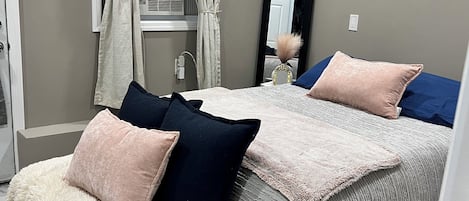
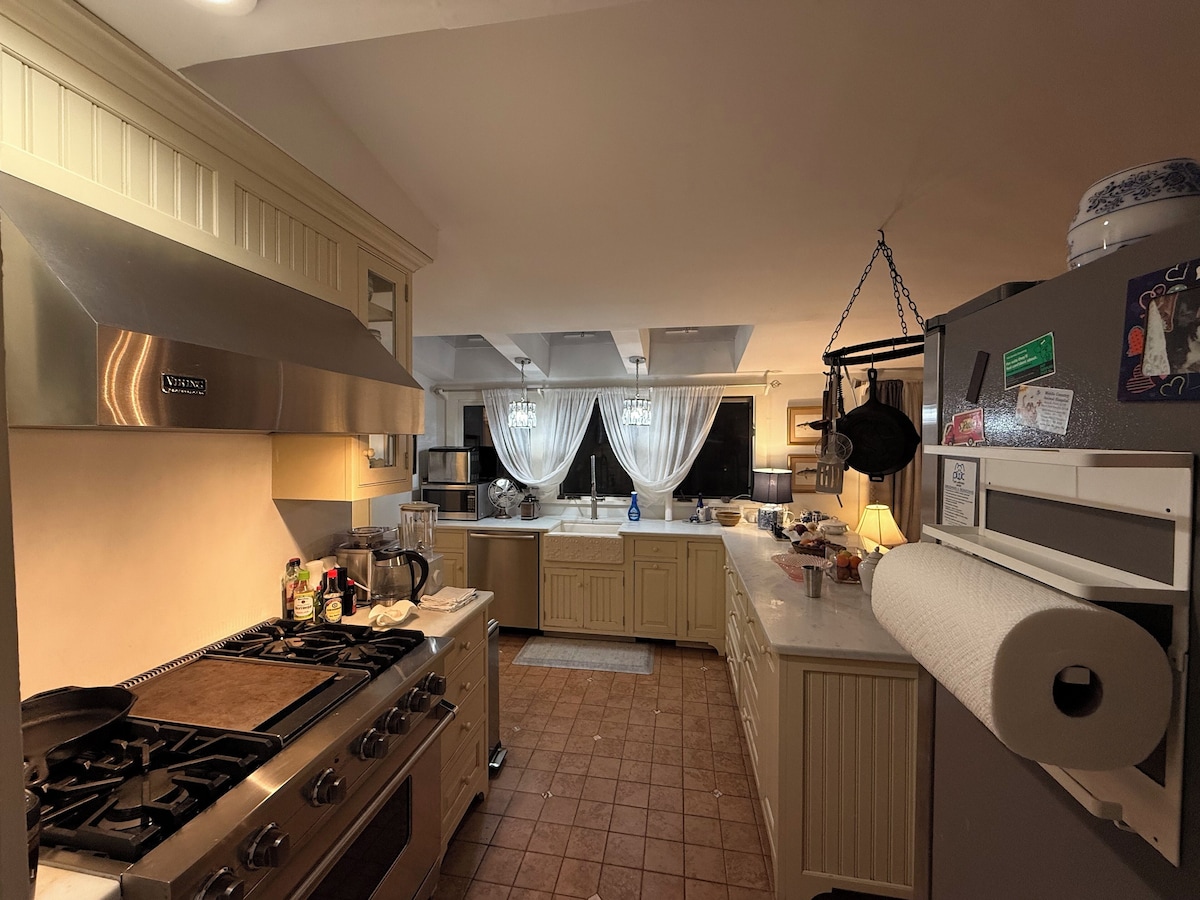
Step into this legacy at the Timeless Fusion Retreat, where 1846’s maritime soul meets 1920s Art Deco glamour, 1950s mid-century whimsy, and 2025’s sleek innovation. The antique four-poster bed, protected by modern steel slats, cradles you in Victorian splendor, while glass shelves gleam with curated treasures—porcelain from Shanghai voyages, milk glass vases evoking post-war optimism, and Deco lamps casting golden light. The eat-in kitchen/family area, with its commercial gas stove and marble counters, invites communal meals, perhaps inspired by Harriet’s recipes, under high ceilings that flood the space with harbor breezes. A plush sofa bed in the nook pulls out to a full-size haven for extra guests, blending comfort with the era’s playful curves.
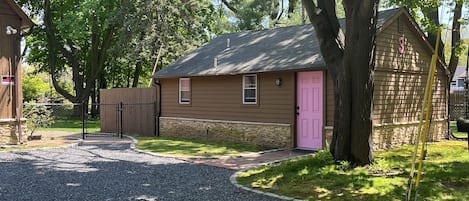
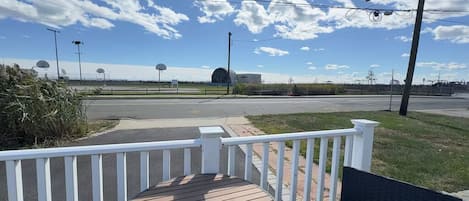
The private deck, overlooking a lush garden, offers al fresco evenings reminiscent of Hawkins’ sea captains’ quarters, with wicker chairs and string lights for stargazing. Laundry facilities in the basement (watch the 5’8” ceiling) ensure hassle-free stays, while free parking and Wi-Fi keep you connected to the world beyond the Sound.
Nestled in Port Jefferson’s heart—two minutes from 20+ waterfront restaurants, the LIRR ferry to Connecticut, and a short drive from Stony Brook University—this retreat is a portal to Long Island’s soul. Walk cobblestone streets lined with fellow Greek Revival gems, visit the Maritime Explorium for shipbuilding lore, or kayak the harbor where Hawkins’ vessels once launched. For families, it’s a serene base for beach days at Cedar Beach; for couples, a romantic nod to the village’s whaling past.
Old homes aren’t for everyone, but when one picks you, it’s magic. We were fortunate—now it’s your turn. Book now and let the Timeless Fusion Retreat transport you to an era of sails and stories, where history isn’t just seen, but felt. Lovingly restored and maintained by the MacDuff-Henderson Family. The proceeds from your stay go back into the home to ensure it is well maintained and gives back by sharing its wonderful heritage with you.

Step back 180+ years in time to this charming large 1-bedroom apartment in a beautifully preserved early 1800’s historic—NYS Registered—home built by a 19th century ship wright, builder and sea captain (with a colorful past) in the heart of Port Jefferson Village. Perfect for couples or small families seeking a serene and cozy getaway, this spacious retreat blends vintage elegance reflecting the 1846 historic charm, 1920s Art Deco, 1950s mid-century, and 2025 modern elements, with modern comforts—think commercial gas stove and oven, dark wood floors, high ceilings, and large windows flooding the space with natural light all day long. Private and secluded right in the middle of the village. Don’t feel like cooking? You’re two minutes from 20+ restaurants. Free parking, Wi-Fi, and laundry included. Book now for your escape! Old homes aren’t for everyone, they say sometimes the home picks you—we were fortunate to have had this home pick us!
To truly appreciate the Timeless Fusion Retreat at 118 South Street, one must delve into the rich tapestry of its history, a story woven from the salt-sprayed sails of Long Island’s maritime golden age and the enduring spirit of American ingenuity. Constructed circa 1846 by Edward Hawkins, a master shipbuilder whose life embodied the rugged determination of 19th-century American enterprise, this Greek Revival gem stands as a living monument to Port Jefferson’s pivotal role in the nation’s seafaring legacy. Born on July 14, 1819, in the quiet hamlet of Bayport, Long Island, Edward learned the craft of shipbuilding in Derby, Connecticut, honing his skills amid the clatter of hammers and the scent of fresh-hewn oak. By the early 1840s, he had returned to his native Suffolk County, establishing himself in Port Jefferson—a bustling shipbuilding center that, by mid-century, boasted over a dozen yards crafting vessels that plied the Atlantic trade routes.
Port Jefferson, then known as Drowned Meadow, was no sleepy village; it was a vital artery in Long Island’s maritime economy, a microcosm of America’s explosive growth during the antebellum era. In the 1840s, the village hummed with the labor of craftsmen like Hawkins, whose hands shaped schooners and brigs that carried goods from New York Harbor to the Caribbean and beyond. This was the heyday of American shipbuilding on Long Island, where Suffolk County’s North Shore yards—fueled by abundant timber from the island’s pine barrens and skilled artisans from Connecticut—produced hundreds of vessels annually. Hawkins himself contributed to this legacy, working in the Brooklyn Navy Yard before venturing to Shanghai, China, in 1854, where he labored in the bustling shipyards of the Qing Dynasty’s dry docks. There, amid the exotic fusion of Eastern and Western technologies, he helped construct the first dry dock for large vessels in the region, a feat that bridged continents and symbolized America’s expanding global reach.
Returning in 1844, Hawkins settled in Port Jefferson, marrying Harriet Davis Swezey on December 18, 1867, in a union that blended two prominent Long Island families—the Swezeys, farmers and merchants of Setauket, and the Hawkins, shipwrights of Bayport.
Their life at 118 South Street was one of quiet domesticity amid the roar of the shipyards. The couple welcomed two children: Edward Eugene in 1845 and Harriet Augusta in 1848, both born in the home’s sunlit rooms that overlooked the harbor’s ceaseless activity. Edward’s career as a ship carpenter and captain reflected the broader American narrative of the era—the Jacksonian spirit of self-made men forging empires on the waves. Long Island’s maritime culture, rooted in the whaling voyages of the 17th century and exploding with the clipper ship boom of the 1840s and 1850s, was the backbone of the young nation’s economy. Port Jefferson alone launched over 1,000 vessels between 1800 and 1900, many crewed by local sons like Hawkins, who navigated the treacherous China trade, transporting tea, silk, and porcelain that filled the homes of Suffolk’s emerging middle class. This trade not only enriched the region but also infused American culture with Eastern influences—evident in the Hawkins House’s subtle nods to global aesthetics, from its tapered porch columns inspired by ancient temples to the resilient shingle siding that withstood the salty gales of Long Island Sound.
Architecturally, the Hawkins House exemplifies the Greek Revival style that swept America in the 1830s and 1840s, a democratic response to the Federal period’s formality. With its five-bay facade—symmetrical windows flanked by two-over-six sash panes, framed by tapered Doric columns on the entry porch—the home embodies the era’s ideal of classical simplicity and republican virtue. Shingle siding, a hallmark of Long Island’s vernacular architecture, clads the structure in a texture that echoes the island’s maritime resilience, while old glass windows distort the light in a way that whispers of hand-blown craftsmanship. Inside, the five-bay layout opens to a flowing parlor and bedroom, where molded pilasters and corner blocks frame doorways like sentinels from ancient Athens. This style, popularized by architects like Minard Lafever and Alexander Jackson Davis, symbolized America’s aspiration to emulate the democratic ideals of Periclean Greece, a fitting backdrop for a shipbuilder whose vessels carried the stars and stripes to distant shores.
The Hawkins family’s story is inseparable from Long Island’s cultural mosaic. Suffolk County, with its fertile farms and rugged coast, was a cradle of American innovation in the 19th century. Shipbuilding here wasn’t just trade; it was identity—a fusion of Yankee ingenuity and immigrant labor that built the U.S. Navy’s backbone during the War of 1812 and fueled the clipper ship era. Edward’s voyage to Shanghai in 1854, during the Taiping Rebellion, placed him at the crossroads of East and West, a microcosm of America’s opening to global commerce via the Treaty of Wanghia (1844). Harriet, daughter of the Swezey family, brought agrarian roots to this seafaring life, her lineage tracing to early Quaker settlers who shaped Long Island’s communal ethos. Their children, Edward Eugene and Harriet Augusta, grew up in a home that bridged these worlds: the parlor echoing with tales of typhoons and tea clippers, the kitchen fragrant with recipes from both shores.
Tragedy struck in 1874 when Edward died on March 23, buried in Middle Island Cemetery, leaving Harriet to raise the family amid the fading shipyards. Port Jefferson’s maritime heyday waned with the Civil War’s end and steamships’ rise, but the Hawkins House endured, its Greek Revival form a testament to the era’s optimism. Today, as part of the Port Jefferson Village Historic District (listed 2006), it stands among 98 contributing structures, a preserved slice of Suffolk’s heritage. Long Island’s maritime culture—celebrated in museums like the Maritime Explorium and annual festivals—lives on in such homes, reminding us of the island’s role in America’s ascent from colonial outpost to global power.
The Hawkins House, with its tapered columns and old glass panes, whispers of the shipwrights who built not just vessels, but the very backbone of the republic.
Step into this legacy at the Timeless Fusion Retreat, where 1846’s maritime soul meets 1920s Art Deco glamour, 1950s mid-century whimsy, and 2025’s sleek innovation. The antique four-poster bed, protected by modern steel slats, cradles you in Victorian splendor, while glass shelves gleam with curated treasures—porcelain from Shanghai voyages, milk glass vases evoking post-war optimism, and Deco lamps casting golden light. The eat-in kitchen/family area, with its commercial gas stove and marble counters, invites communal meals, perhaps inspired by Harriet’s recipes, under high ceilings that flood the space with harbor breezes. A plush sofa bed in the nook pulls out to a full-size haven for extra guests, blending comfort with the era’s playful curves.
The private deck, overlooking a lush garden, offers al fresco evenings reminiscent of Hawkins’ sea captains’ quarters, with wicker chairs and string lights for stargazing. Laundry facilities in the basement (watch the 5’8” ceiling) ensure hassle-free stays, while free parking and Wi-Fi keep you connected to the world beyond the Sound.
Nestled in Port Jefferson’s heart—two minutes from 20+ waterfront restaurants, the LIRR ferry to Connecticut, and a short drive from Stony Brook University—this retreat is a portal to Long Island’s soul. Walk cobblestone streets lined with fellow Greek Revival gems, visit the Maritime Explorium for shipbuilding lore, or kayak the harbor where Hawkins’ vessels once launched. For families, it’s a serene base for beach days at Cedar Beach; for couples, a romantic nod to the village’s whaling past.
Old homes aren’t for everyone, but when one picks you, it’s magic. We were fortunate—now it’s your turn. Book now and let the Timeless Fusion Retreat transport you to an era of sails and stories, where history isn’t just seen, but felt. Lovingly restored and maintained by the MacDuff-Henderson Family. The proceeds from your stay go back into the home to ensure it is well maintained and gives back by sharing its wonderful heritage with you.
Gib zur Preisangabe die Daten an
Ausstattung
Waschmaschine
Wäschetrockner
Haustierfreundlich
Kostenloses WLAN
Klimaanlage
Außenbereich
Ähnliche Unterkünfte

Spacious one Bedroom Apt with private entrance
- Küche
- Klimaanlage
- Grill
- Mikrowelle
7.8 von 10, Gut, (10 Bewertungen)
Hausordnung
Check-in ab 16:00 Uhr
Mindestalter für die Miete: 18 Jahre
Check-out vor 11:00 Uhr
Kinder
Kinder (0–17 Jahre) erlaubt
Veranstaltungen
Veranstaltungen sind nicht gestattet
Haustiere
Haustiere erlaubt: Hunde und Katzen (insgesamt maximal 2)
Rauchen
Rauchen ist nicht gestattet
Hinweise für den Check-out
Der Gastgeber bittet darum, vor dem Check-out Folgendes zu erledigen:
Geschirrspüler einräumen
Benutzte Betten abziehen und gebrauchte Handtücher einsammeln
Persönliche Gegenstände entfernen, übrig gebliebene Lebensmittel und Getränke entfernen und Abfall entsorgen
Lichter aussschalten, Türen abschließen und Schlüssel zurückgeben
Die Nichtbeachtung dieser Anweisungen kann zu einer negativen Bewertung durch den Gastgeber führen.
Wichtige Informationen
Wissenswertes
Diese Unterkunft wird von einem privaten Gastgeber verwaltet (eine Partei, die nicht im Rahmen ihrer gewerblichen, geschäftlichen oder beruflichen Tätigkeit handelt). Das EU-Verbraucherrecht, einschließlich Widerrufsrecht, gilt nicht für deine Buchung, sie wird jedoch von den vom privaten Gastgeber festgelegten Stornierungsbedingungen abgedeckt.
Für zusätzliche Personen fallen möglicherweise Gebühren an, die abhängig von den Bestimmungen der Unterkunft variieren können.
Beim Check-in werden ggf. ein Lichtbildausweis und eine Kreditkarte, Debitkarte oder Kaution in bar für unvorhergesehene Aufwendungen verlangt.
Je nach Verfügbarkeit beim Check-in wird versucht, Sonderwünschen entgegenzukommen, sie können jedoch nicht garantiert werden. Eventuell fallen zusätzliche Gebühren an.
Partys oder Gruppenveranstaltungen sind auf dem Gelände der Unterkunft streng verboten.
Langzeitmieter sind willkommen.
Der Gastgeber hat angegeben, dass die Unterkunft über einen Kohlenmonoxidmelder verfügt
Der Gastgeber hat angegeben, dass es in der Unterkunft einen Rauchmelder gibt
Diese Unterkunft verfügt über Außenbereiche wie Balkone oder Terrassen, die möglicherweise nicht für Kinder geeignet sind. Bei Bedenken wende dich am besten vor deiner Ankunft direkt an die Unterkunft, um sicherzustellen, dass dir ein passendes Zimmer zur Verfügung gestellt wird.
Zur Gegend
Port Jefferson
Mitten in Port Jefferson befindet sich dieses Apartment. Theatre Three und Mather House Museum sind ideale Ziele für kulturell Interessierte, während sich Folgendes anbietet, wenn du einen Ausflug unternehmen möchtest: Port Jefferson und Harmony Vineyards (Weingut). Du möchtest deinen Aufenthalt in der Stadt mit dem Besuch eines spannenden Events oder einer Sportveranstaltung aufpeppen? Dann schau doch einmal hier vorbei: Island Federal Credit Union Arena oder Long Island Community Hospital Amphitheater.
Port Jefferson, NY
In der Umgebung
- Mather House Museum - 3 Gehminuten - 0.3 km
- St. Charles Hospital - 5 Gehminuten - 0.5 km
- Harborfront Park - 6 Gehminuten - 0.6 km
- Port Jefferson - 8 Gehminuten - 0.7 km
- John T Mather Memorial Hospital Of Port Jefferson New York - 14 Gehminuten - 1.2 km
Fortbewegung vor Ort
Restaurants
- Danfords Hotel & Marina - 7 Gehminuten
- Billie's 1890 Saloon - 3 Gehminuten
- PJ Lobster House - 4 Gehminuten
- The Whiskey Barrel - 4 Gehminuten
- Starbucks - 4 Gehminuten
Häufig gestellte Fragen
Bewertungen
10
Außergewöhnlich
Die Bewertungen werden in chronologischer Reihenfolge angezeigt, unterliegen einem Moderationsprozess und wurden verifiziert, sofern nicht anders angegeben.
Mehr erfahrenWird in einem neuen Fenster geöffnet9,4/10
Sauberkeit
10/10
Check-in
10/10
Kommunikation
10/10
Lage
10/10
Genauigkeit des Onlineauftritts
Bewertungen
8. Dez. 2025
Gut: Sauberkeit, Check-in, Kommunikation, Lage und Genauigkeit des Onlineauftritts
Aufenthalt von 2 Nächten im Dezember 2025
10/10 – Hervorragend
Claire P.
2. Nov. 2025
Gut: Sauberkeit, Check-in, Kommunikation, Lage und Genauigkeit des Onlineauftritts
Claire P.
Aufenthalt von 3 Nächten im Oktober 2025
10/10 – Hervorragend
Kelly J.
26. Okt. 2025
Gut: Sauberkeit, Check-in, Kommunikation, Lage und Genauigkeit des Onlineauftritts
Kelly J.
Aufenthalt von 2 Nächten im Oktober 2025
Über den Gastgeber
Zu Gast bei William Henderson
Old homes aren’t for everyone, they say sometimes the home picks you, we were fortunate to have had this home pick us! Historically registered, built by an 19th century shipbuilder and captain. I too am a licensed commercial captain, and can also trace lineage to 17th century Salem, Massachusetts and Athens, Georgia, in many ways our history channels that of Edward Hawkins. When you understand that the wood and many features of the home were hand tooled and crafted using 19th century tools and the wood came from dismantled ships in the harbor and those ships came from all over the world you get a sense of just how special this home is to us. We want to share this unique piece of American history while using the proceeds from your stay to ensure the home will continue to endure the next 180 years.
Darum fiel die Entscheidung auf diese Unterkunft
This particular street in referred to as captains row, as each home was built and owned by a shipbuilder and or captain. One unique feature of the street is walking up the block at night you can get a great sense of any impending weather changes, something that would have been very important for the sea captains to be aware of.
Das macht diese Unterkunft einzigartig
We are in great company, as having many houses on this street also being historical, however we are open to those who come to visit and so you too can enjoy our home as well.
Premium-Gastgeber
Sie bieten ihren Gästen durchgehend großartige Erfahrungen.
Wie können wir unsere Website verbessern?Feedback geben